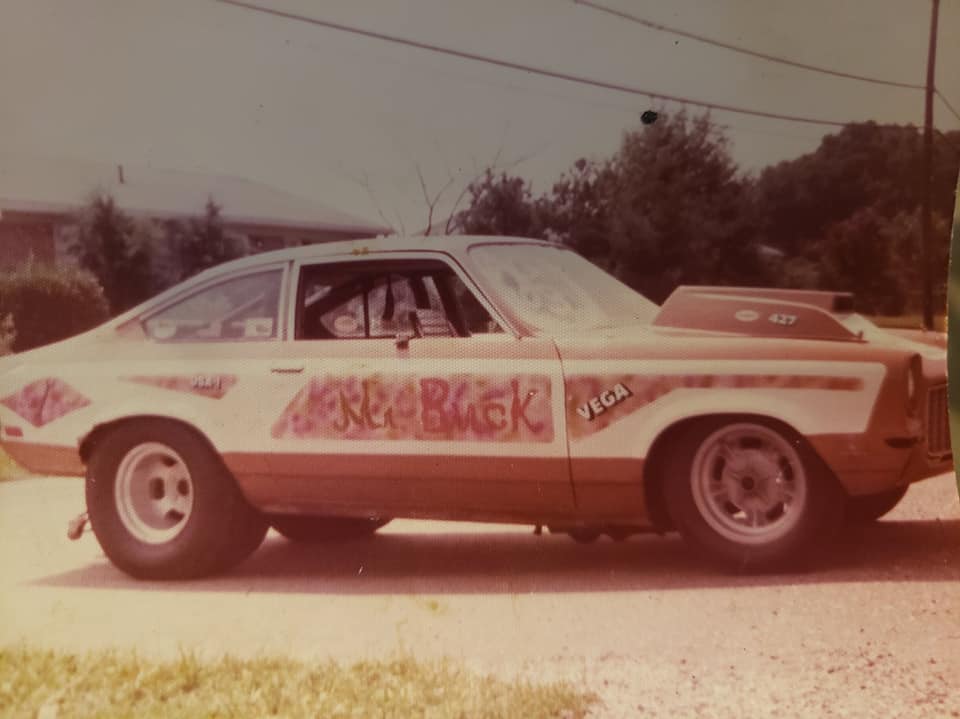
During some weekends, after we competed in our bowling league, we went ‘to the country’, about 20 miles south of where we lived, to very rural Southern Maryland. My grandfather sold produce on the side of the country road. And we had to count and weigh the peaches to put in the little green baskets. White peaches cut up with a splash of Vitamin milk and a spoonful of sugar was one of my favorite summertime treats.
On the way back home, we’d often visit our relatives with their small brick homes on huge acreage. We played volleyball, tetherball, and yard games, and checked out our cousins race cars or motocross bikes. My family did drag racing at Budd’s Creek. The men raced and the women worked on their cars. My Uncle Buck worked at the White House as a heavy equipment operator mechanic for over 30 years.
And he also built custom race cars. He once told me that he got his first toolbox when he was 8 years old. He took apart an engine and reassembled it and his best friends dad raced cars. And he also raced on the i95 Beltway in Maryland before it was open to the public! How crazy cool is that?!
Meanwhile, in upstate rural South Carolina, my mom’s family did farming or worked in factories. They built kayaks, Singer sewing machines, BMW’s, and more. I spent many summers there, for a month or more. The highlight of the summer, going to Ms. Loree’s house where we could make ice cream from scratch, eat fresh cakes and pies, learn how to make our own icing, biscuits, and food from scratch. And bonus, she had air conditioning even on her covered porch where we could sit, read books, and play cards, dominoes, and board games.
As a child growing up in the 1980’s without the distraction of the internet or video games, or having to listen to folks arguing over politics — this lifestyle was A LOT of fun!
Rural America has long been the largely overlooked and dare I say under-appreciated driving force behind the U.S. economy and building great work ethics, self-reliance, and solid family experiences (even if you may not appreciate them when you are young). Ask any person who knows how to figure things out, tinker, and has a hard work ethic and you will probably find a direct association to farms, manufacturers, or growing up in a small town in rural America. Yet for decades, rural businesses have faced a frustrating and depressing reality: the more remote the community, the harder it is to access the capital needed to grow.
That’s exactly why the USDA Rural Development suite of programs was created and why I am excited to announce this program. It’s intention, create jobs in rural areas, and keep hope alive for the generations to come.
Among these programs, the USDA Business & Industry (B&I) Loan Guarantee Program was created to help rebuild and expand local economies. It is one of the most powerful loan programs available to standalone rural businesses seeking commercial financing. The #1 Goal – JOB CREATION!
Today, I would like to explain, how it works, who qualifies, and how it compares to other USDA programs for business owners, lenders, developers, and economic development professionals operating in rural markets.
What Is the USDA Business & Industry Loan Guarantee Program?
The USDA B&I Loan Guarantee Program is managed by USDA Rural Development and operates through a partnership with private lenders — banks, credit unions, and Community Development Financial Institutions (CDFIs). Rather than lending money directly, the USDA guarantees a significant portion of the loan, reducing lender risk and opening the door to capital that would otherwise be completely inaccessible in rural markets.
IMPORTANT NOTE: All the programs that you hear about such as USDA, SBA, etc. are never funds that are loaned by them directly. So you cannot contact the SBA and apply for a loan. You must go through one of their approved lenders. And YES! We absolutely can help you with applying for this loan.
Here’s some quick numbers:
Guarantee percentages scale with loan size:
80% for loans up to $5 million,
70% for loans between $5 million and $10 million, and
60% for loans exceeding $10 million.
This tiered structure was designed to ensure both smaller rural businesses and larger commercial projects can both compete and grow in their respective markets.
Who Qualifies?
The B&I program serves a broad range of borrower types — for-profit businesses, nonprofits, cooperatives, federally recognized tribes, and public bodies — but for the purposes of standalone commercial operations, the for-profit business category is the primary focus.
- Eligible businesses must be organized as a legal entity: an LLC, corporation, partnership, or sole proprietorship all qualify.
- Beyond legal structure, the program requires borrowers to demonstrate meaningful financial commitment.
- Equity investment of 10 to 25 percent is typically required depending on the deal structure,
- and a minimum debt service coverage ratio of 1.25x is expected. (But if you have been following my posts for a while, you already know this)!
- Lenders will also require a feasibility study or detailed business plan for most transactions, particularly for start-up ventures.
Standalone Business Checklist:
- Location: Business must be in a rural area outside a city or town with 50,000+ population
- Legal Structure: LLC, corporation, partnership, or sole proprietorship
- Equity Injection: 10–25% typically required from borrower
- Personal Guarantees: All owners holding 20% or more must provide a full personal guarantee
- Collateral: Must be sufficient to secure the loan — real estate, equipment, inventory are all acceptable
It’s important to underscore the recourse nature of B&I loans.
These are full recourse loans which means if you default on the loan, they can come for your personal assets.
The USDA guarantee protects the lender, not the borrower (sigh). Owners with 20% or greater equity stakes must execute personal guarantees, meaning personal assets — not just business assets — are on the line in the event of default.
Understanding Rural Eligibility
Geographic eligibility is one of the most frequently misunderstood aspects of the B&I program. The USDA defines a “rural area” as any city, village, township, or unincorporated area that is not part of an urban area and has a population that does not exceed 50,000 inhabitants.
Priority consideration is given to areas with populations of 25,000 or fewer.
This means that many suburban-adjacent communities that are gentrifying may qualify — particularly in states where large land areas separate the major population centers. The USDA maintains an interactive eligibility map that allows borrowers and lenders to verify specific addresses before committing to the application process. Or we can help you figure this out as well.
What Can the Loan Be Used For?
The B&I program is designed to be flexible enough to support a wide range of commercial needs.
Eligible uses include:
- Real estate purchase and construction,
- equipment and machinery acquisition,
- working capital (typically capped at 30% of total loan proceeds),
- business acquisition and conversion,
- select debt refinancing under specific conditions,
- and start-up costs for new enterprises.
What the program explicitly prohibits is equally important for prospective borrowers is largely special purpose facilities! These are places that can only be used for their designated use and cannot easily be converted to something else if that business type fails. Think – golf courses, racetracks, gambling facilities, bowling alleys, amusement parks, churches. Also lending institutions cannot receive B&I financing.
Businesses that primarily serve urban populations outside the eligible rural zone are also excluded, reinforcing the program’s focused mission to strengthen rural communities specifically.“The B&I program doesn’t just fund businesses — it funds the infrastructure of rural economic life. Every loan that closes represents jobs created, goods produced, and a community that chose to stay viable rather than disappear.”
Industries That Qualify
One of the B&I program’s greatest strengths is its focused on supporting economic diversification in rural communities. I talk more about the importance of economic diversification in my video where I discuss choosing a market to invest in.
Eligible industries include manufacturing, retail and wholesale trade, healthcare and medical facilities, hospitality (hotels and restaurants), agriculture-related businesses including processing and value-added operations, renewable energy, technology, professional services, transportation and logistics, and food processing.The reason for this is to help rural economies from depending and in many cases suffering from over-reliance on a single industry. If there is an economic downturn, effectively the majority of the town can lose it’s major source of income and produce a downward spin in housing defaults, lack of ability to support other businesses, and more.
Program Comparison: B&I, Section 515, and Section 538
USDA Rural Development operates a portfolio of programs beyond B&I, most notably the Section 515 Rural Rental Housing Direct Loan program and the Section 538 Multifamily Housing Loan Guarantee. Understanding the difference between all three is critical — particularly for developers and lenders who may encounter all three in different project contexts.
The comparison chart below breaks down the key structural differences across all three programs, covering loan basics, borrower eligibility, property types, financial requirements, etc:
| USDA B&I | Section 515 | Section 538 | |
|---|---|---|---|
| Loan Mechanism | Guarantee (up to 80%) | Direct Government Loan | Guarantee (up to 90%) |
| Eligible Borrowers | For-profits, nonprofits, cooperatives, tribes | Developers, nonprofits, public agencies | Private developers, nonprofits |
| Property / Use | Commercial & business use only | Multifamily rental (5+ units) | Multifamily rental (5+ units) |
| Income Targeting | N/A | Low-to-very-low income | Low-to-moderate income |
| Rural Required | Yes | Yes | Yes |
| Recourse | Full — personal guarantee ≥20% owners | Yes | Yes |
Financial Comparison
| USDA B&I | Section 515 | Section 538 | |
|---|---|---|---|
| Max Loan | Up to $25M ($40M energy/co-ops) | Varies by project | Varies by project |
| Guarantee Rate | 60–80% (slides by loan size) | Direct — no guarantee | Up to 90% |
| Equity Injection | 10–25% typically required | Subsidized terms available | Varies by project |
| Job Creation | Yes — mandatory | No | No |
| Lender Role | Private lender; USDA guarantees | USDA is the lender | Private lender; USDA guarantees |
| DSCR Required | Min. 1.25x | USDA underwriting | Lender / USDA jointly |
The Real Economic Impact
Behind every B&I loan is a business owner who took a risk on their hometown, a lender who extended credit, and a community that gained jobs, tax revenue, and gave locals another reason to stay.
When a food processing facility opens in a rural county with B&I financing, it doesn’t just hire its own workers — it buys from local farmers, contracts local trucking companies, fills local restaurants at lunch, and generates property and payroll taxes that fund schools and roads. Imagine the possibilities and growth over the course of a generation. And hopefully that young person who thought of moving away to the big city, stays local, and helps continue growing their family business.
Frequently Asked Questions About USDA B&I Loans
How long does the B&I application process take?
Share this post to support rural economic awareness!